
Education and training
Seminars and webinars
We provide training and skill development in key areas of artificial intelligence, including deep learning, natural language processing, and explainable AI. We address the challenges and opportunities of applying AI in the digital humanities, covering topics such as data curation, dataset annotation, classification, multimedia analysis, and prompt engineering for large language models (LLMs). In addition, a dedicated course on the ethics of AI will be offered. Together, these activities address the growing need for enhanced digital skills and AI literacy among digital humanities and social sciences scholars in the era of digital transformation.
Are you a digital humanities and social sciences scholar and want to become proficient in using AI in your research? Here is a pathway to general AI proficiency:
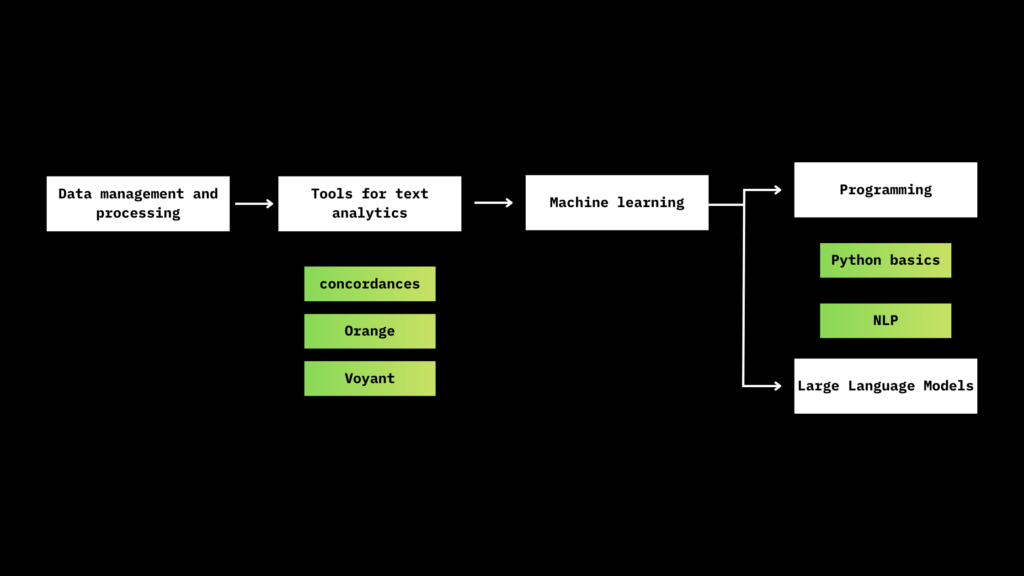 First, it is essential to understand the data, as covered in the Data Management and Processing course. Next, we proceed to high-level analysis using no-code tools such as concordancers, Voyant, and Orange. After this, participants are introduced to the key concepts of machine learning, gaining at least an overview of its main techniques and approaches. Finally, they can choose to advance further by learning programming (Python, NLP) and/or exploring how to use large language models (LLMs) effectively in research contexts.