Can AI Agents Automatically Detect Fairy-Tale Motifs and Tale Types?
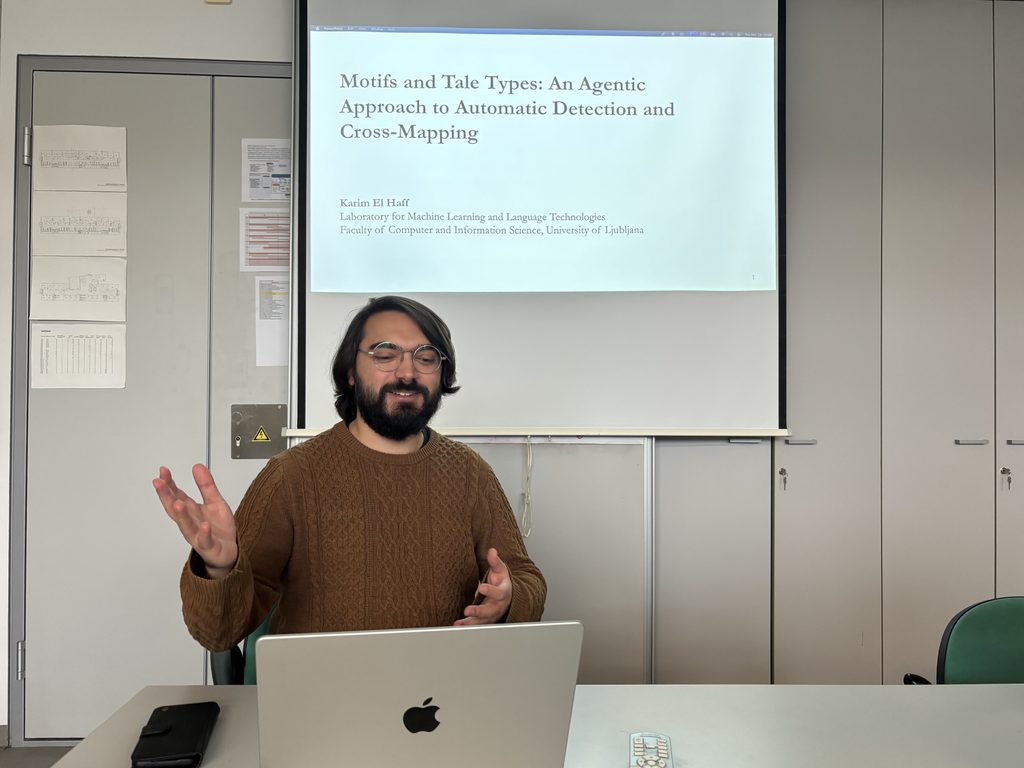
Can artificial intelligence identify recurring motifs and classify fairy tales according to established folkloristic catalogues? This was the central question explored by postdoctoral researcher Dr Karim El Haff, who presented his ongoing research at the lab.
His work investigates an agentic approach to the automatic detection and cross-mapping of fairy-tale motifs and tale types, bringing together the fields of folkloristics and artificial intelligence.
Fairy tales are traditionally classified according to established cataloguing systems. One of the most widely used is the Aarne–Thompson–Uther (ATU) Index, which identifies approximately 2,250 tale types. Tales can also be classified according to their recurring motifs. The Thompson Motif-Index (TMI) is one of the most widely used reference systems, containing approximately 46,000 different motifs.
Karim El Haff’s research explores several questions at the intersection of AI and folkloristics: Can AI automatically identify ATU tale types and TMI motifs in fairy tales, while providing evidence for its classifications? Which motifs appear in tales belonging to a particular type, and how much variation exists between them? How do automatically identified motifs compare with those documented in established catalogues? And, finally, could the motifs identified in a previously unclassified tale help determine its tale type?
Although these questions remain open, you can explore Karim’s previous research on the topic in his article, Annotating the Outlaw-Hero: Evaluating Large Language Models on a Folkloristic Classification Task.